


agentfm-core
AgentFM is a peer-to-peer network that turns everyday computers into a decentralized AI supercomputer. AgentFM lets you run massive AI workloads directly across
Sign in to rate this tool.
Overview
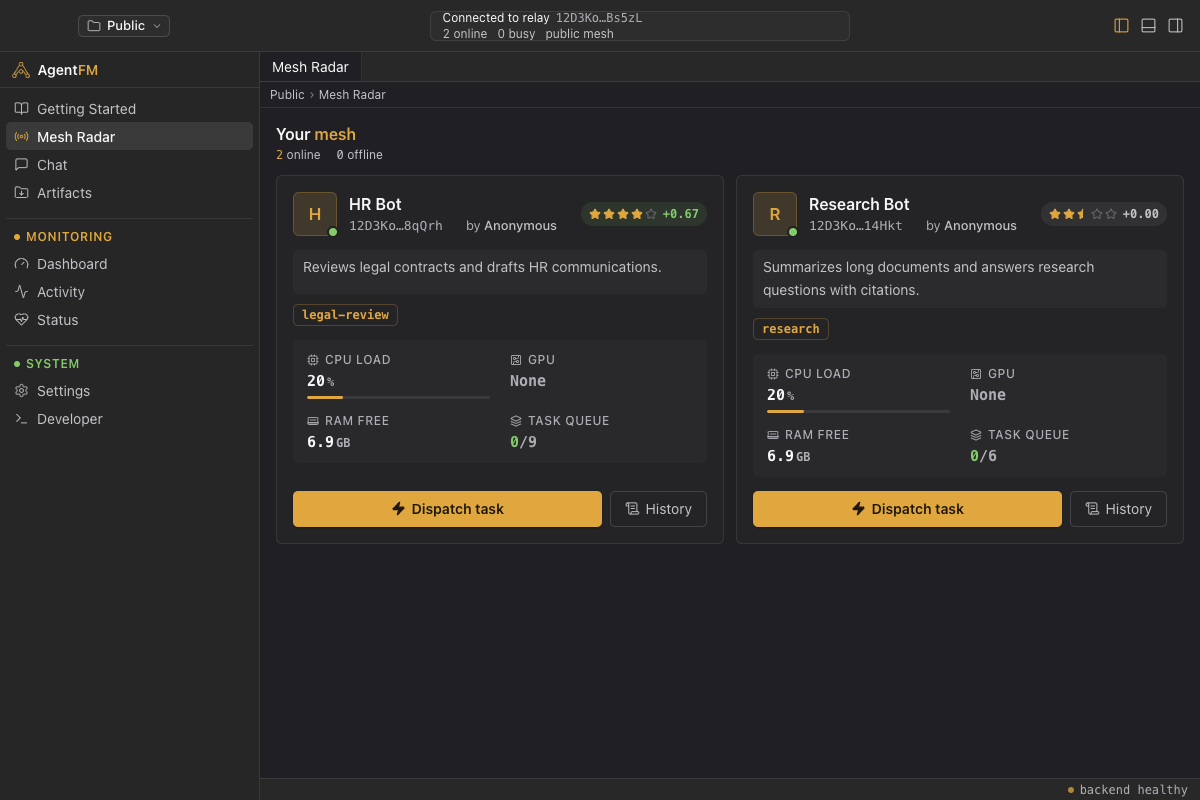
AgentFM turns the computers you already own into a peer‑to‑peer mesh that can run AI agents without a cloud account. You package an agent as a container, drop it onto the mesh, and dispatch tasks from a desktop app or any OpenAI SDK. The system keeps data on the machines you choose and encrypts traffic end‑to‑end.
The mesh is built from three roles that share a single binary. Workers run your agent in a fresh Podman sandbox, broadcasting CPU, GPU, RAM and queue depth every two seconds. A relay node on a public IP handles discovery, NAT traversal and stores a trust ledger so the network survives restarts. The API mode lets you send tasks from a desktop client, a curl command, or any OpenAI SDK; results stream back token by token and any files are returned as a zipped artifact.
If you have spare hardware, a workstation, a gaming rig, or an office mini PC, you can add it to the mesh simply by installing the AgentFM binary. The install script (`curl -fsSL https://api.agentfm.net/install.sh | bash`) works on macOS for both Intel and M‑series chips. After installation you run the binary with a mode flag (`-mode worker`, `-mode relay`, or `-mode api`). Workers spin up a new Podman container for each task, ensuring the host environment never touches the agent code. Output streams live over a libp2p channel, and any files the agent writes are collected into a zip that appears in your local artifacts folder.
The platform includes a trust system that checks reputation before routing a task. Each result receives an Ed25519‑signed rating that is appended to an append‑only Merkle log, providing verifiable proof that the work was performed by the advertised peer. Ratings are weighted by EigenTrust, and equivocal behavior is detected by witnesses and rejected across the mesh. The desktop app bundles a full node, letting you monitor agents, dispatch work, view live streams, and rate results without using a terminal.
Key features
- Peer‑to‑peer mesh runs on idle CPUs and GPUs you already own
- Agents execute in isolated Podman containers for each task
- Live token‑by‑token output streaming over encrypted libp2p channels
- File artifacts returned as zipped bundles with signed receipts
- Reputation system with Ed25519‑signed ratings stored in a Merkle log
Details
- Pricing
- Free
- Category
- Art
Suggest an edit
Sign in to suggest an edit.
Pros and cons
Pros
- No cloud account required, keeping data on selected machines
- End‑to‑end encryption protects traffic between peers
- Trust gate and signed ratings give verifiable accountability
- Supports macOS Intel and M‑series hardware out of the box
Cons
- Requires manual approval of the beta app on macOS due to lack of notarization
- No pricing information is published on the site
- Users must manage their own hardware and network connectivity for the mesh.
Alternatives
 ColoringPagesToolsColoringPagesTools is a library of free printable coloring pages and coloring books for kids, teens and adults. Every page is labeled by theme, difficulty and age, and downloads as a…
 Tootoon GptGenerates sketch videos from one-sentence stories using ChatGPT and style transfer.
 Packify AIPackify is an AI packaging design platform that describes itself as the first AI packaging design agent.
 LakesailLakeSail is a data and AI platform built around Sail, an open-source compute engine written in Rust that is compatible with Apache Spark.
 Scenario ComScenario is an AI platform for creative production and game assets.
 JumperJumper is a machine-learning search engine for video footage, built for editors.
 Modal ComModal is cloud infrastructure for teams that develop, train and serve AI applications.
 GowhisperPrivacy-focused desktop app for local audio transcription.
 Contentstudio IoContentStudio is a social media management platform built around an AI agent that learns your brand.
 Orquesta AI PromptsOrq.ai is an enterprise AI platform built in the EU.
 VizardVizard is an AI video editing and clipping tool that turns long-form videos into short clips for TikTok, Instagram and YouTube Shorts.
 Imaginario AIImaginario AI is a video intelligence platform for marketing and post-production teams.