


Sign in to rate this tool.
Overview
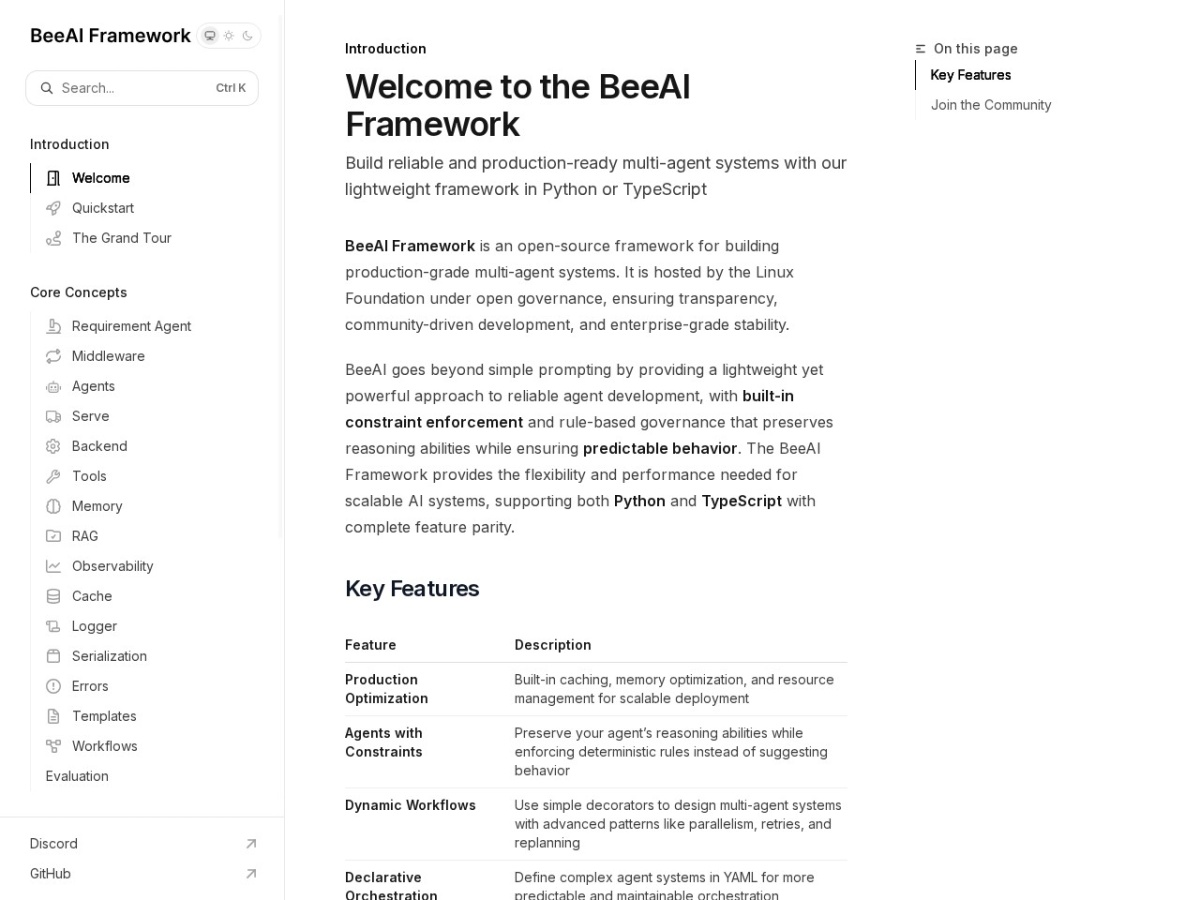
BeeAI Framework is an open‑source toolkit that lets you build production‑grade multi‑agent systems in either Python or TypeScript. The project is maintained under the Linux Foundation's open‑governance model, which means the code is publicly available, the roadmap is community‑driven, and the stack targets enterprise‑level stability.
In practice, the framework sits around a lightweight runtime that manages a collection of agents. Each agent can be defined as a Python class or a TypeScript interface, and the framework handles the lifecycle, calling the agent's logic with a structured request payload. For a typical request, you supply a JSON input that matches the agent's prompt schema, and the agent returns a JSON output that can be consumed by downstream agents. The runtime enforces rules that keep an agent's reasoning deterministic; for example, constraints can declare that a particular token or a data type must not be used, or that a response must always contain a certain field.
Workflow construction uses decorators in the code or a declarative YAML file. When you annotate a function with @parallel, the framework launches separate agent instances concurrently. A @retry decorator automatically re‑invokes the agent up to a configured number of attempts if the result does not meet the success criteria. Replanning is supported by allowing the agent to return a new task description, which the runtime queues and sends to another agent for execution. The YAML approach lets you define agents, transport rules, and event triggers in a single file, making it clearer how data flows through the system.
BeeAI ships with built‑in caching, memory optimization, and resource management hooks. Caching stores the result of an agent call keyed by the input, avoiding redundant calls to expensive LLM models. Memory optimization limits the size of the conversation context kept in memory, while resource management ties into the underlying compute platform to throttle concurrency and volume. These features are exposed automatically in the Python and TypeScript APIs, so you need not write custom code for them.
The framework supports more than ten LLM providers, identified by name in the configuration. Switching providers simply involves passing a new provider string or object; the framework handles instantiation. This works smoothly for Ollama, Groq, OpenAI, Watsonx.ai, and others.
Details
- Pricing
- Free
- Category
- Language
Suggest an edit
Sign in to suggest an edit.
Pros and cons
Pros
- Open‑source and Linux Foundation‑hosted
- Dual language universality
- Built‑in constraint enforcement for predictable behaviour
- Rich workflow decorators and YAML orchestration
- Native observability via OpenTelemetry
Cons
- No published pricing or usage limits
- Documentation shows only core features; example projects are limited
- Provider list is extensive but not guaranteed to cover niche models
- No GUI or low‑code interface described in the docs
Alternatives
 AdminforthAdminForth is an open-source, self-hosted framework for building back-office and admin panels, released under the MIT license.
 TavilyTavily is a search engine built for AI agents and large language model applications.
 LitellmLiteLLM is an open-source AI gateway and LLM proxy for platform teams.
 Kilo AIKilo, also known as Kilo Code, is an open-source AI coding agent.
 DynamiqDynamiq is an agentic AI platform for building and running AI agents for back-office automation and customer support, by voice and by chat.
 Querio 1 0Querio is an AI data analytics platform built around the idea of analytics as code.
 ComposioComposio is a platform that gives AI agents secure access to external apps and tools.
 ResearchpalResearchPal is an AI-powered workspace for researchers and students.
 Quizbot AIQuizbot.ai is an AI quiz and question generator.
 Dhtmlx ChatbotDHTMLX Chatbot is a JavaScript UI widget for building chat interfaces for AI support agents and assistants.
 OpensilverOpenSilver is an open-source framework for building web applications with C# and XAML, as used by WPF and Silverlight.
 Modal ComModal is cloud infrastructure for teams that develop, train and serve AI applications.