


Sign in to rate this tool.
Overview
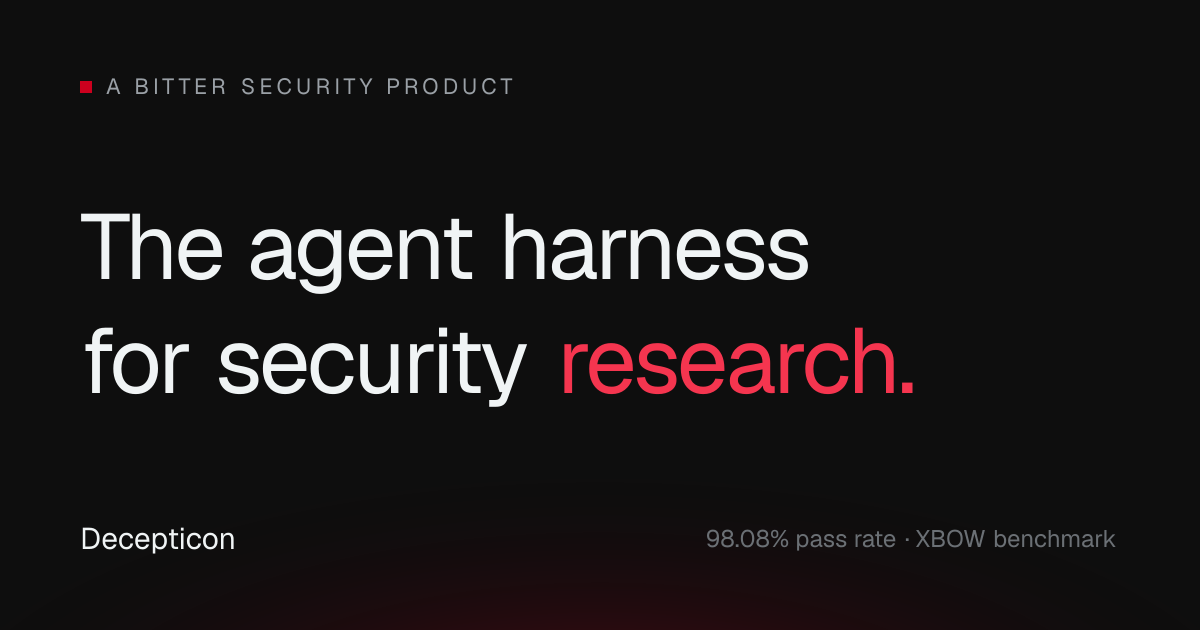
Decepticon is marketed as an autonomous hacking agent designed for red‑team and security‑research work. It acts as a use that brings together specialist sub‑agents, tools, infrastructure components, and evidence collection inside a scope that you approve. The product is developed by Bitter Security and is positioned as a way to run coordinated offensive operations without leaving the control of the operator.
The workflow starts with an “intent” interview that builds an OPPLAN. During this guided questionnaire you specify the target scope, rules of engagement, and the objectives you want the operation to achieve. The system records these parameters and uses them to enforce boundaries at runtime. Once the OPPLAN is saved, Decepticon launches a series of sub‑agents that each handle a phase of the attack lifecycle, reconnaissance, initial access, and post‑exploitation. These agents are tied to ATT&CK techniques and Skillogy playbooks, so their actions follow documented tactics rather than a single generic prompt. As each sub‑agent runs, you can watch its commands and results in real time on the workspace UI. The output includes logs, screenshots, and any artifacts that the agent gathers, all stored as evidence linked to the original objective.
Safety mechanisms are built into the platform. Before any command is sent to a target, Decepticon checks whether the action falls inside the approved scope and rules of engagement. If the action is out‑of‑scope, it is blocked and the operator is notified, preserving the OPSEC posture. This design means you remain in control of the run; you can approve or reject pivots, adjust objectives, and add new evidence as the operation evolves.
A read‑only sample workspace is available directly on the website without requiring an account. The sample uses pre‑saved data to illustrate how an operation is assembled, how sub‑agents are orchestrated, and how evidence is captured. It does not execute live tests, so you can explore the interface safely. For real engagements against authorized targets you must create a separate account, and the site refers you to a pricing page for Solo and Pro tiers. Access to live operations is handled separately from the free sample.
The listing also provides benchmark data: Decepticon achieved a 98.08 % pass rate on the XBOW validation benchmark, solving 102 of 104 real‑world exploitation challenges.
Details
- Pricing
- Free
- Category
- Research
Suggest an edit
Sign in to suggest an edit.
Pros and cons
Pros
- Structured interview ensures clear definition of scope and objectives, reducing accidental out‑of‑scope activity
- Sub‑agents are tied to known ATT&CK techniques, providing transparent, technique‑level visibility
- Real‑time monitoring lets you verify each step and collect evidence automatically
- High benchmark pass rate indicates strong capability on a recognized exploitation suite
Cons
- Live operations require a paid account; the free sample does not allow testing against real targets
- Pricing information is only referenced, not detailed in the listing, so cost cannot be evaluated from this page
- No user case studies or third‑party audits are provided to corroborate the benchmark claim.
Alternatives
 ResearchpalResearchPal is an AI-powered workspace for researchers and students.
 AndreANDRE is an AI-powered survey data analyst for customer experience work.
 Copyowl AICopyOwl is an AI agent for deep research and writing.
 ConsensusConsensus searches peer-reviewed papers and writes cited answers, with a Consensus Meter that shows how the evidence splits on yes/no questions.
 CosineCosine describes itself as a sovereign AI lab.
 Lakera GuardLakera is a security platform for generative AI.
 DartDart describes itself as the workplace for the agent era.
 Vengo AIVengo AI is enterprise infrastructure for generative AI search and AI agents.
 ComposioComposio is a platform that gives AI agents secure access to external apps and tools.
 HarveyHarvey is an AI platform for legal and professional services.
 OpenservOpenServ builds infrastructure for AI agents, aimed at enterprises, governments and what it calls the autonomous economy.
 HubtypeHubtype is a platform for designing, launching and managing AI agents on WhatsApp and other business messaging channels.