


deer-flow
An open-source long-horizon SuperAgent harness that researches, codes, and creates. With the help of sandboxes, memories, tools, skill, subagents and message ga
Sign in to rate this tool.
Overview
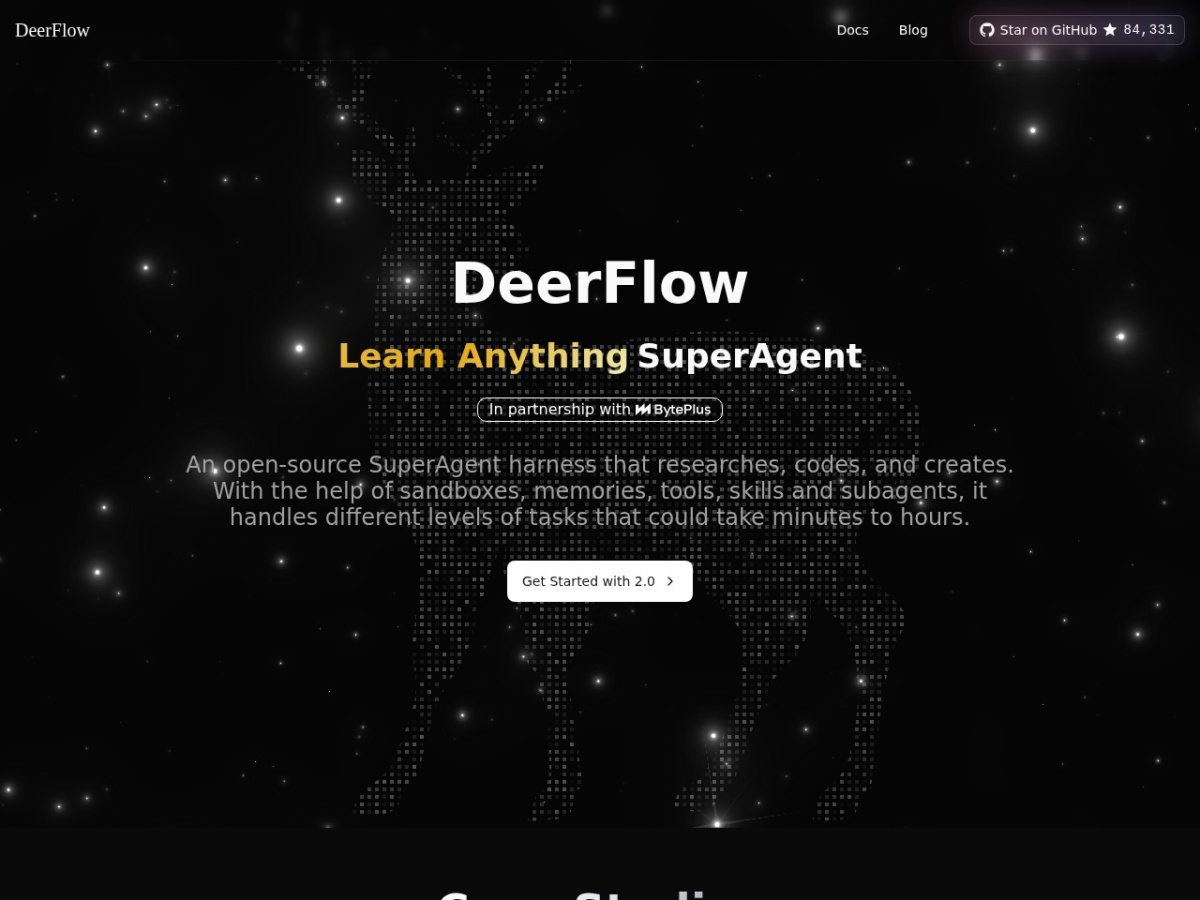
DeerFlow is an open‑source LangChain‑based framework for building super agents that research, code, and generate content. It runs inside a Docker‑based sandbox and lets developers add only the skills they need. The project is hosted on GitHub and the latest release, DeerFlow 2.0, shifts from a simple research agent to a full‑stack super agent.
The engine is a use that divides a task into subagents. Each subagent runs a skill such as web search, file I/O, or video creation. The use passes messages through a gateway, stores history in a memory component, and retrieves the appropriate subagent when a new step is required. In practice, you tell DeerFlow, for example, “Generate a video from a scene in Pride and Prejudice.” The agent searches the novel, pulls the relevant text, and then loads a video‑generation skill. The output comes back as a video file and a reference image. Similar chains produce webpages, data‑analysis reports, or summarized podcasts. While the framework supports any input that can be converted to a prompt, typical inputs are natural‑language instructions, URLs, or dataset files. Outputs are usually files or structured data that the skill writes to the sandbox's persistent file system.
DeerFlow's sandbox is an “all‑in‑one” Docker container that bundles a browser, shell, file system, MCP, and VSCode Server. This makes it safe to run untrusted code while still giving the agent full compute power. Tasks that run for minutes or hours run inside this container, so there is no risk of corrupting the host environment. Skills are loaded on demand; for instance, a “web‑search” skill pulls a lightweight library only when a request for external data appears. The memory component keeps a log of all prior messages, ensuring continuity across long tasks.
The tool is ideal for developers who want to prototype multi‑step AI workflows without building a full‑featured web service. It is also useful for researchers who need to automate long research tasks, such as creating deep‑research reports or exploring datasets. It requires a Docker‑enabled machine and some comfort with command‑line interfaces. The documentation emphasizes example scripts and community contributions rather than a detailed API guide, so new users may need to inspect the GitHub repository for deeper insights.
Details
- Pricing
- Free
- Category
- Research
Suggest an edit
Sign in to suggest an edit.
Pros and cons
Pros
- Fully open source with community contributions on GitHub
- Secure isolated runtime ensuring host safety
- Flexible skill architecture that scales with task complexity
- Pre‑built examples covering a range of content‑generation scenarios
- Lightweight deployment via Docker containers
Cons
- No published pricing or commercial licensing information
- Requires Docker and basic command‑line familiarity
- Limited documentation beyond introductory examples
- No explicit performance benchmarks or scaling limits mentioned
Alternatives
 Copyowl AICopyOwl is an AI agent for deep research and writing.
 ConsensusConsensus searches peer-reviewed papers and writes cited answers, with a Consensus Meter that shows how the evidence splits on yes/no questions.
 ResearchpalResearchPal is an AI-powered workspace for researchers and students.
 AdminforthAdminForth is an open-source, self-hosted framework for building back-office and admin panels, released under the MIT license.
 Claude AIClaude review (October 2026): Anthropic's AI assistant, key features, verified Free, Pro, Max and Team pricing, pros, cons and alternatives.
 GrokGrok is xAI's chatbot with live web and X search, image and video generation, voice mode and a multi-agent option for hard questions.
 Perplexity AIPerplexity review (October 2026): the AI answer engine's features, verified Pro, Max and Enterprise pricing, pros, cons and alternatives on AIMAPER.
 Blend EdBlend-ed is a learning management system built specifically for professional training providers.
 Maxim AIBifrost is an AI gateway made by Maxim AI.
 ChatGPTChatGPT review (October 2026): features, verified Free, Go, Plus and Pro pricing, who it suits, pros, cons and alternatives on AIMAPER.
 MindstudioMindStudio is a platform for building powerful AI agents for yourself, your team or your enterprise without coding.
 EarlyaiEarly Release Guard, from Early AI (startearly.ai), is a tool for software teams that want to spend less time repairing bugs.