


doris
Apache Doris is a real-time analytics and hybrid search database for AI agents.
Sign in to rate this tool.
Overview
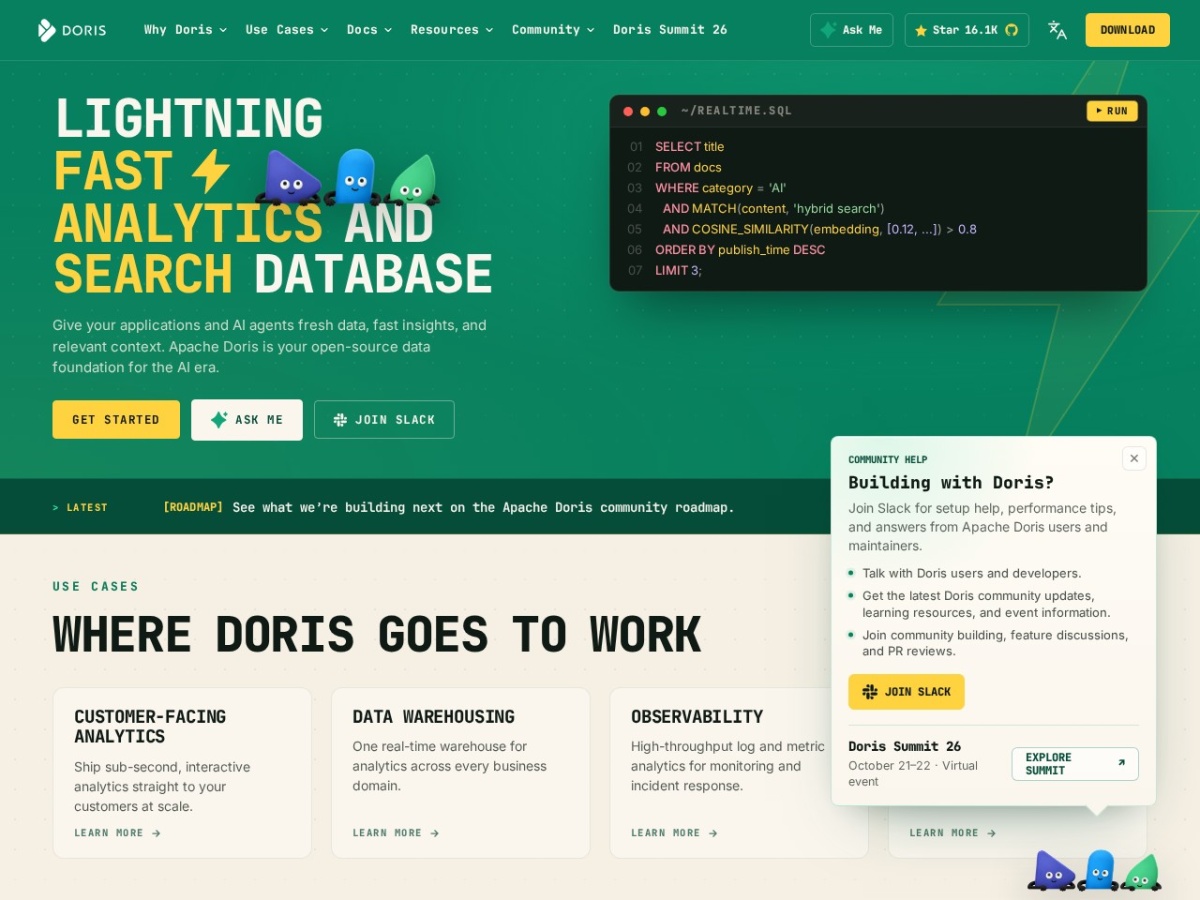
Apache Doris is an open‑source, real‑time analytics and hybrid search database designed specifically for AI agents and applications that need quick, relevant context. It lives at https://doris.apache.org/ and markets itself as a data foundation for the AI era, offering fast SQL access across a range of data types.
In practice, Doris lets you store structured, semi‑structured and unstructured data, such as vectors, text, JSON and log streams, together in a way that can be queried with standard SQL. For example, an AI model might push embeddings and related metadata into a table, and then your application can retrieve the nearest vectors with a single SQL statement that returns the matching IDs, scores and supporting fields. The system also exposes a profile analysis workspace, where you can open a slow‑query log file and the tool marks the problematic steps, giving you visibility into what parts of a query cost time.
The tool is aimed at data teams that run interactive analytics for customers, monitor business health, or analyze telemetry from large‑scale services. A portfolio of case studies shows use by companies like Baidu for log analytics, Xiaomi for device telemetry, and miHoYo for player‑behavior analysis. The database works best when your workloads need sub‑second response times and need to combine structured analytics with search across vectors and text. It is less suited to batch‑heavy ETL pipelines that involve complex transformations outside the scope of a traditional SQL query.
Your typical input to Doris is an SQL query that may include JOINs, aggregations, filters and a nearest‑neighbor clause on vectors. The output is a result set delivered to your client or application in row format, just as you would receive from any relational database. The system integrates with standard JDBC/ODBC drivers, so existing BI and analytics tools can connect without additional adapters.
The site also mentions a free 101 course to learn the fundamentals, and a Slack channel for community support. The roadmap page lists planned features but does not provide release dates or pricing. No details are given about data ingestion frameworks, index types, or higher‑level APIs beyond SQL.
Key features
- Real‑time, sub‑second analytics on structured and semi‑structured data
- Hybrid search that unifies vector, text, and JSON search in one SQL query
- Profile Analysis workspace to diagnose and visualize slow queries
Details
- Pricing
- Free
- Category
- Analytics
Suggest an edit
Sign in to suggest an edit.
Pros and cons
Pros
- Unified SQL interface for both analytics and search over diverse data types
- Open source with active community and free educational materials
- Added diagnostic workspace for performance troubleshooting
- Supports high‑throughput log and metric streams for observability
Cons
- No published pricing or managed‑service options disclosed
- Limited details on data ingestion pipelines or supported connectors
- Documentation focuses on capabilities rather than deployment depth
- Lacks official uptime or scaling benchmarks in the public listing
Alternatives
 Querio 1 0Querio is an AI data analytics platform built around the idea of analytics as code.
 Smartbids AISmartBids.ai is AI-powered real estate pricing and analytics software for agents and brokerages.
 LakesailLakeSail is a data and AI platform built around Sail, an open-source compute engine written in Rust that is compatible with Apache Spark.
 Qdrant IoQdrant is a high-performance vector search engine and database.
 TavilyTavily is a search engine built for AI agents and large language model applications.
 Quadratic MultiplayerQuadratic is an AI spreadsheet that connects to your data sources and helps you analyse them in a familiar grid.
 NotamifyNotamify is an AI tool for pilots and flight operations teams that decodes NOTAMs (Notices to Air Missions).
 Granter AIGranter is an AI agent for grant funding.
 My Real Estate Listing AIMy Real Estate Listing is an AI tool for real estate agents that turns property details and photos into a finished brochure.
 RoketfyRoketfy is an AI customer review analytics and ecommerce data platform.
 OpensilverOpenSilver is an open-source framework for building web applications with C# and XAML, as used by WPF and Silverlight.
 EntergramEntergram is a Telegram CRM built as a layer 2 on top of Telegram for teams running many personal Telegram accounts. Its MCP server covers every account on your seat,...