


lobu
Open-source control plane and runtime for organisational agents: shared company context & brain
Sign in to rate this tool.
Overview
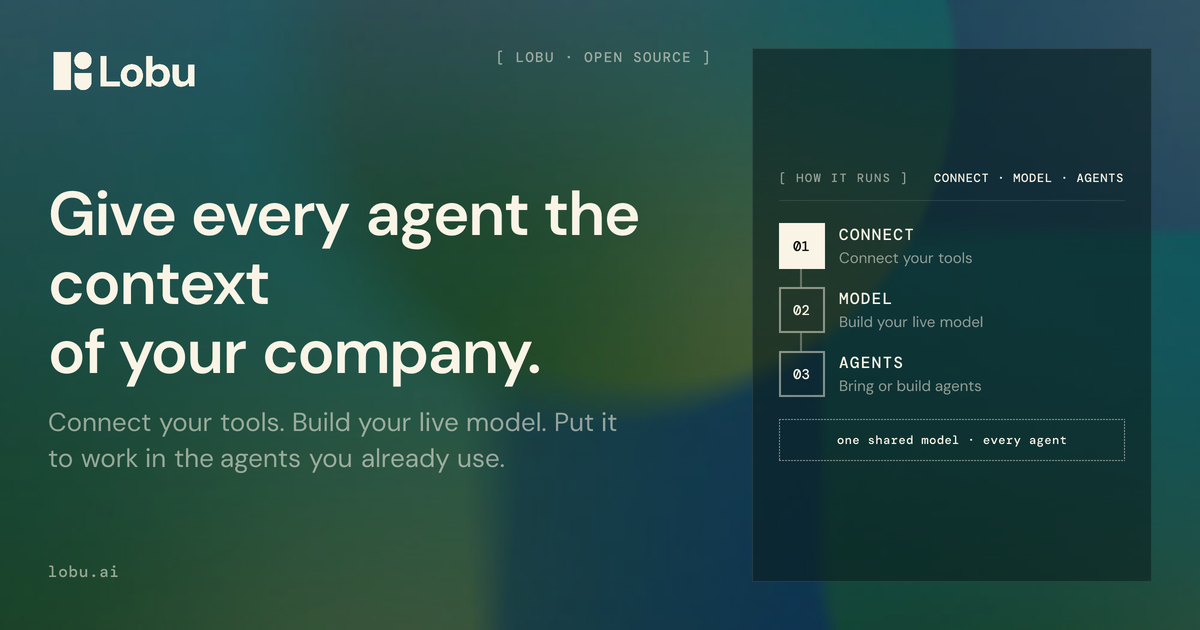
Lobu is an open‑source control plane and runtime that lets you keep a shared workspace for both people and AI agents within your organization. It aims to bring together company knowledge, tools, and ongoing work so that humans and agents can reference the same context and continue each other's tasks.
The platform works by connecting to the services you already use, Gmail, PostgreSQL, Jira, Slack, Google Chat, Claude, ChatGPT, and others, through configurable connectors. Once a connector is installed, it streams data such as emails, database rows, or ticket updates into a central workspace where agents can read and act on the information. You can add custom connectors by writing TypeScript code that defines the data source, the fields to sync, and the schedule for updates.
In the workspace you define entity types like “Company” or “Person” and relationship types such as “Works At” using a simple configuration file. These definitions create a typed graph of your business data that agents can query with SQL‑like statements. For example, a query can pull recent renewal events for a specific customer, combine them with usage metrics, and surface a summary for a human teammate. The system also supports automations that trigger actions, sending a Slack reminder, creating a task in Jira, or updating a Salesforce record, based on the events that flow into the workspace.
Lobu can be run on your own infrastructure or accessed as a hosted cloud service. A Mac application and a Chrome extension let you interact with the workspace from a desktop or directly within browser tabs. The interface shows connected entities, their fields, and the relationships between them, allowing you to explore public knowledge about people and companies, contribute new information, and let other agents build on it.
Key features
- Open‑source control plane with self‑hosted or cloud deployment options
- Connectors for Gmail, PostgreSQL, Jira, Slack, Google Chat, Claude, ChatGPT, etc.
- Custom connector development using TypeScript and the @lobu/connector‑sdk
- Typed entity and relationship modeling via configuration files
- Query language for retrieving events and context across entities
- Automation hooks that can invoke actions in connected services
Details
- Pricing
- Free
- Category
- Agents
Suggest an edit
Sign in to suggest an edit.
Pros and cons
Pros
- Supports a wide range of existing tools through built‑in connectors
- Allows custom data sources via code, giving flexibility for unique workflows
- Provides a shared, queryable graph of entities and relationships for agents and humans
- Offers both desktop (Mac) and browser (Chrome) clients for convenient access
Cons
- Pricing information is not published on the site
- Requires technical effort to write and maintain custom connectors and entity definitions
- No explicit mention of built‑in analytics or visualization dashboards beyond the entity map.
Alternatives
 Vengo AIVengo AI is enterprise infrastructure for generative AI search and AI agents.
 CirclechatCircleChat is a team chat app in which AI agents work alongside people.
 Resleeve AIResleeve is a workspace that puts your team and AI bots in the same place.
 Sourcery SentinelSourcery is an AI code reviewer for pull requests on GitHub and GitLab.
 EnconvoEnconvo is an AI agent for macOS that lives across your Mac.
 ManusManus is a general AI agent that plans and carries out multi-step tasks, from research reports to slides and websites, on a credit system.
 ComposioComposio is a platform that gives AI agents secure access to external apps and tools.
 EarlyaiEarly Release Guard, from Early AI (startearly.ai), is a tool for software teams that want to spend less time repairing bugs.
 Featherless LlmFeatherless is a serverless hosting service for open large language models.
 Orquesta AI PromptsOrq.ai is an enterprise AI platform built in the EU.
 DynamiqDynamiq is an agentic AI platform for building and running AI agents for back-office automation and customer support, by voice and by chat.
 Kilo AIKilo, also known as Kilo Code, is an open-source AI coding agent.