


monocle
Monocle is a framework for tracing GenAI app code. This repo contains implementation of Monocle for GenAI apps written in Python.
Sign in to rate this tool.
Overview
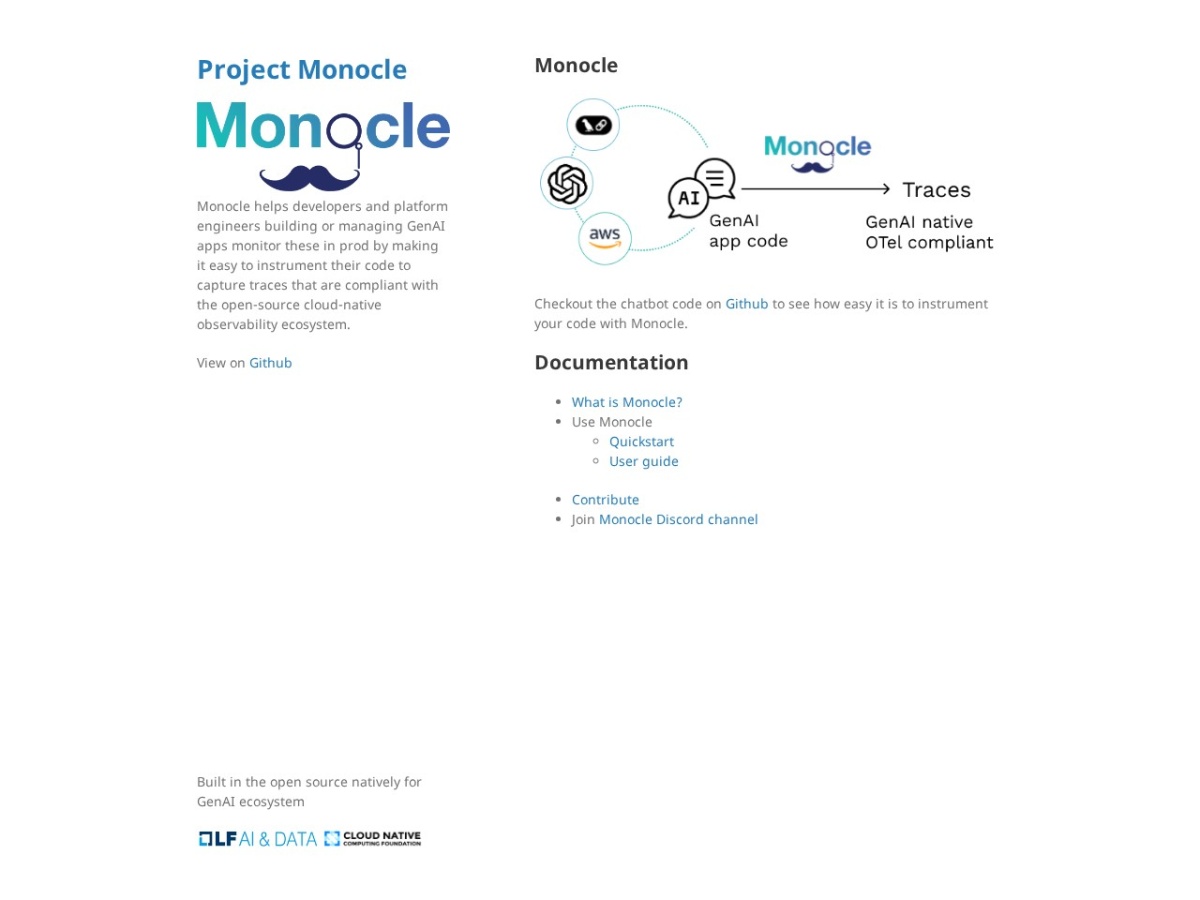
Monocle is an open‑source framework that lets you add tracing to generative AI applications written in Python. It is presented as a tool for developers and platform engineers who need to watch their GenAI services while they run in production. The project lives on GitHub, and a Discord channel is offered for community questions and contributions.
The library's main job is to instrument code so that each request generates a trace that follows the open‑source cloud‑native observability standards, such as OpenTelemetry. In practice you import the Monocle package and wrap a function, often a model inference call or a chatbot handler, with a provided decorator. When the function executes, Monocle creates a span, records attributes like input prompt text, model name, and latency, and then closes the span when the response is returned. The output of the instrumentation is a trace record that can be sent to any back‑end that understands the OpenTelemetry format, for example Jaeger, Prometheus, or Grafana. No custom exporters are required; you configure the destination URL and authentication in a small settings file, and Monocle handles the rest.
The framework is aimed at teams that already have an observability stack and want to extend it to cover their generative AI workloads. If you are building a new model‑serving microservice, a chatbot, or a pipeline that chains multiple LLM calls, Monocle can capture the end‑to‑end flow without rewriting business logic. The quickstart guide on the site shows a minimal chatbot example: a single Python file imports Monocle, adds the decorator to the chat handler, and runs the app. When a user sends a message, the trace includes the incoming request, the prompt sent to the model, and the generated reply, all visible in the chosen tracing UI.
Because the code is open source, you can read how spans are built, modify the library to add custom attributes, or contribute fixes through pull requests. The documentation mentions a user guide that covers setup steps, exporter configuration, and naming conventions for spans. The Discord channel provides a place to ask about integration issues or share patterns. The site does not list any pricing because the software is free to use, and it does not specify support guarantees or service‑level agreements.
Key features
Details
- Pricing
- Free
- Category
- Code
Suggest an edit
Sign in to suggest an edit.
Pros and cons
Pros
- Targets the specific need of tracing generative AI code, a gap in many observability tools
- Minimal code changes required; decorators keep business logic separate from tracing logic
- Works with existing OpenTelemetry ecosystems, avoiding the need for proprietary collectors
- Open‑source repository allows inspection, customization, and community contributions
Cons
- Limited to Python; the listing does not mention support for other programming languages
- No published pricing or commercial support options, which may matter for enterprise teams
- Documentation references external tracing back‑ends but does not provide a built‑in UI
- Performance impact and scalability details are not discussed in the available texts.
Alternatives
 OpensilverOpenSilver is an open-source framework for building web applications with C# and XAML, as used by WPF and Silverlight.
 LitellmLiteLLM is an open-source AI gateway and LLM proxy for platform teams.
 Qdrant IoQdrant is a high-performance vector search engine and database.
 Navamai Enhance Your Craft With AINavamAI is an open-source command-line tool that turns your terminal into a personal AI assistant.
 Maxim AIBifrost is an AI gateway made by Maxim AI.
 MarsaiMarsX is a development platform that combines AI, no-code tools, traditional code and reusable building blocks called MicroApps.
 DynamiqDynamiq is an agentic AI platform for building and running AI agents for back-office automation and customer support, by voice and by chat.
 QodoQodo (formerly CodiumAI) reviews pull requests with multiple AI agents that learn your team's rules, check cross-repo impact and map your services.
 CruderraCruderra is a tool that reads your code repositories and generates documentation and architecture diagrams automatically.
 Sourcery SentinelSourcery is an AI code reviewer for pull requests on GitHub and GitLab.
 Respond IoRespond.io is a business messaging platform for companies that sell and support customers through chat apps.
 Applitools EyesApplitools is an AI-augmented testing platform that combines Visual AI with deterministic checks to catch visual and functional bugs.