


Sign in to rate this tool.
Overview
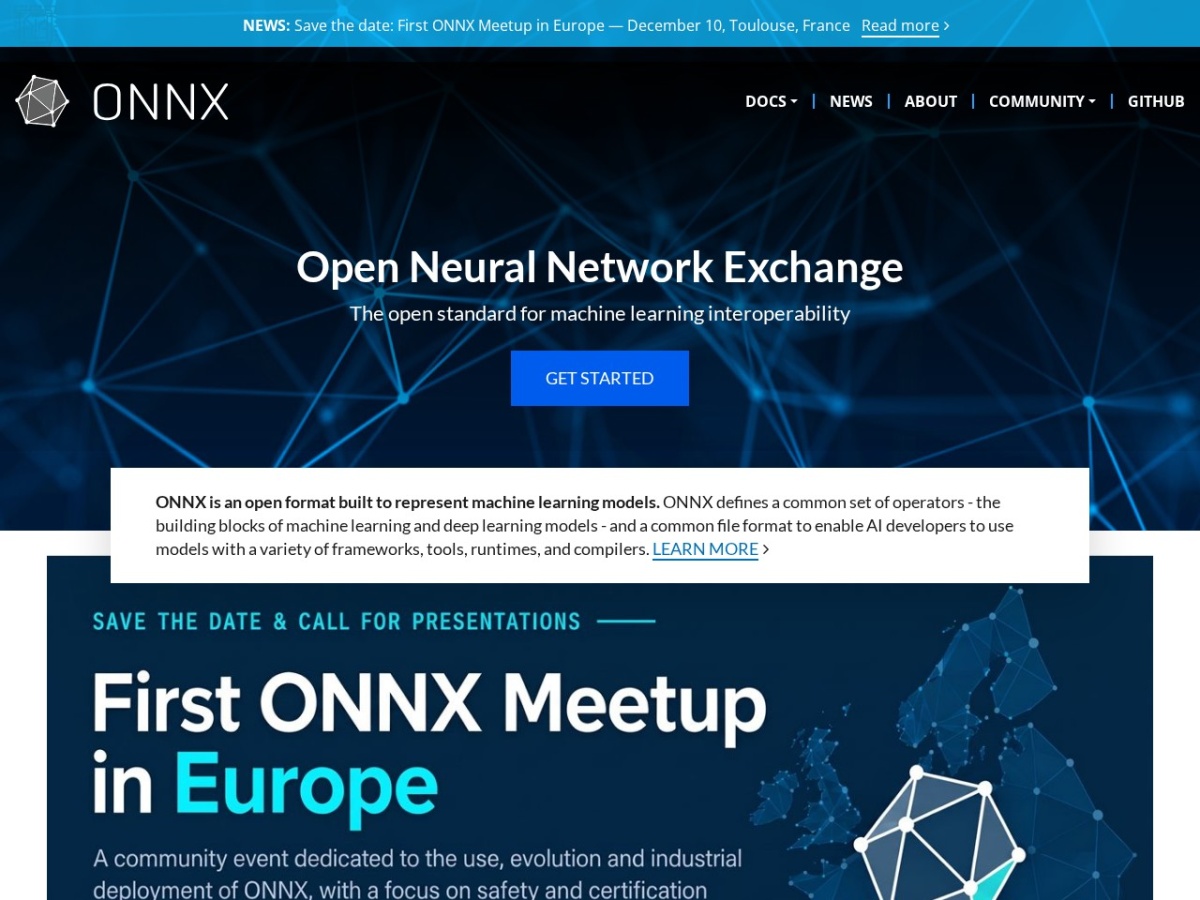
ONNX is an open format built to represent machine learning models in a way that can be moved between different frameworks, tools, runtimes, and compilers. The project defines a common set of operators, the basic computational blocks used in both machine‑learning and deep‑learning models, and stores them in a single file format. You can begin by visiting the home page, where links to “Get Started,” documentation, and community resources are provided.
In practice, you train a model in your preferred framework, such as PyTorch, TensorFlow, or another supported environment, and then export it to the ONNX file format. The exported file contains the model's graph, weights, and the standardized operators, which any ONNX‑compatible runtime can read. This means you can keep your training pipeline unchanged while selecting an inference engine that matches the hardware you intend to use. Typical inputs to an ONNX model are the same tensors you would feed to the original framework model; the output is a set of prediction tensors produced by the runtime, without requiring framework‑specific code at inference time.
The format is aimed at developers who need flexibility in deployment. If you work on research prototypes in one framework but must run the model on edge devices, servers, or specialized AI accelerators, ONNX gives you a path to do so without rewriting the model. Conversely, users who rely on a single framework for both training and inference may not need the extra conversion step, and the listing does not specify any built‑in tools for model training itself.
Hardware access is highlighted as a benefit: ONNX‑compatible runtimes and libraries are designed to exploit optimizations on CPUs, GPUs, and other accelerators. By selecting a runtime that targets a specific accelerator, you can achieve better performance while keeping the model file unchanged. The site mentions “supported accelerators” but does not enumerate them, so you will need to check individual runtimes for exact compatibility.
Community involvement is another practical aspect. ONNX operates under an open governance structure, offering transparency and inclusion. You can join the Slack channel, participate in special interest groups (SIGs), or become part of a working group. The site also advertises events such as the First ONNX Meetup in Europe, and it provides a contribution guide and a travel fund to support community participation.
Details
- Pricing
- Free
- Category
- Learning
Suggest an edit
Sign in to suggest an edit.
Pros and cons
Pros
- Allows you to train in any supported framework and infer with a different engine
- Provides a pathway to use hardware‑specific runtimes without changing the model file
- Active community resources, including Slack and special interest groups, for support
- Clear documentation on exporting models and using the common operator set
Cons
- No pricing or licensing details are provided on the website
- The list of supported frameworks and accelerators is not enumerated in the excerpt
- No built‑in tools for model training or direct performance benchmarking are mentioned.
Alternatives
 Modal ComModal is cloud infrastructure for teams that develop, train and serve AI applications.
 CodefastCodeFast is an online coding course created by Marc Lou, an indie maker known for launching many small software products.
 LakesailLakeSail is a data and AI platform built around Sail, an open-source compute engine written in Rust that is compatible with Apache Spark.
 Faraday AIFaraday is a customer context platform for AI agents and marketing workflows.
 Tolgee AI TranslatorTolgee is a localisation platform for software, and its AI translator speeds up translating apps into other languages.
 Gpt TranslatorAI-powered translation platform using GPT technology for accurate and instant translations.
 RoamaroundRoamaround offers a way to offload routine AI research work so you can focus on higher‑level thinking.
 Talkpal AITalkpal is an AI language learning app that acts as a personal language coach.
 Mple AImple AI is an enterprise platform that aims to guide sales teams in what to do, what to say and how to win each day.
 ResearchpalResearchPal is an AI-powered workspace for researchers and students.
 PixMindPixMind is an AI image and video platform aimed at e-commerce sellers, marketers and content creators.
 Tutor LilyTutor Lily is an AI language tutor focused on speaking and conversation practice.