


Sign in to rate this tool.
Overview
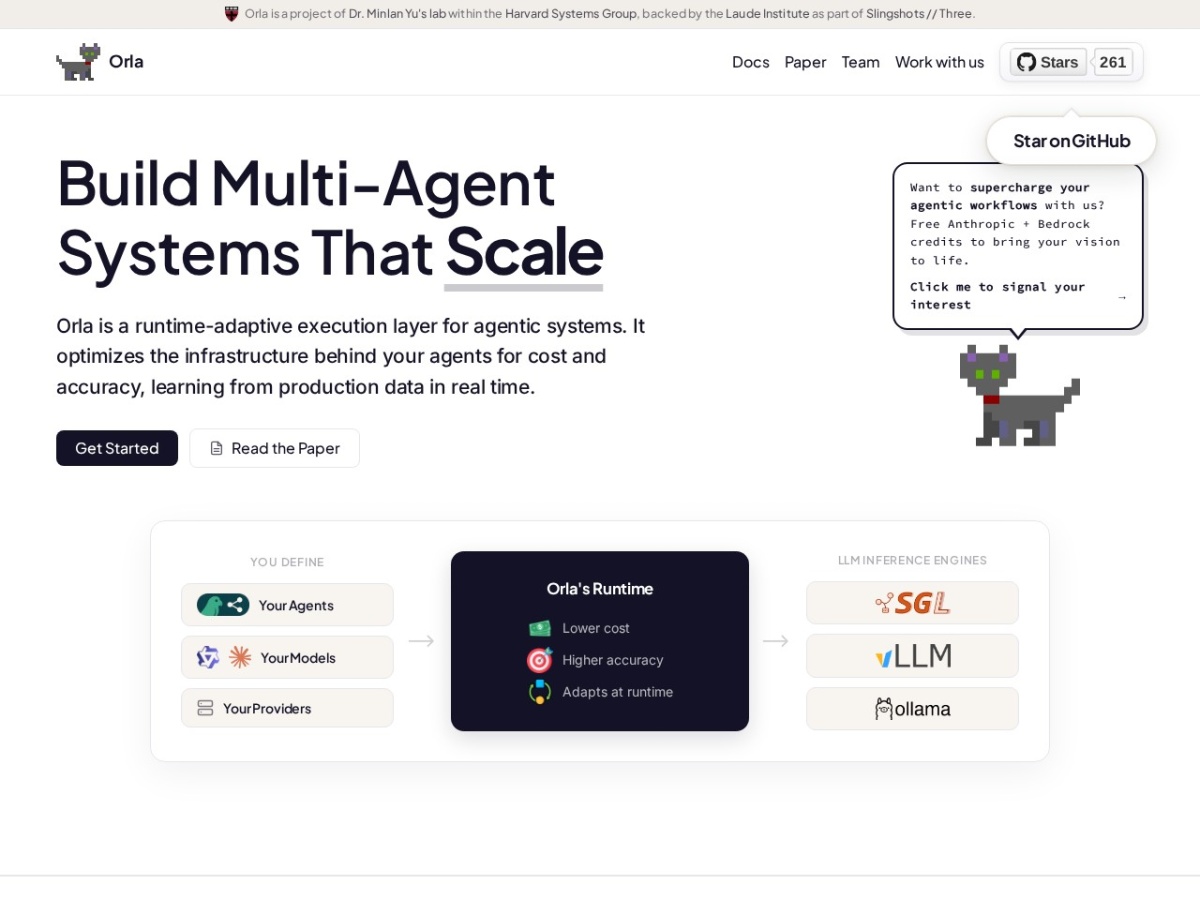
Orla is a runtime‑adaptive execution layer for AI agents, positioned to manage how agents interact with language‑model backends. It watches every call an agent makes, records how costly and accurate that call was, and then uses those observations to steer future calls toward cheaper or higher‑quality models. The system works as a drop‑in replacement for the standard OpenAI client: you change the base URL and add a stage header, and Orla handles the rest.
When an agent runs, each request it sends is tagged with a stage name, such as “search” or “generate”. The Stage Router receives the request, checks its internal mapping for that stage, and proxies the call to the chosen backend. Supported backends include SGLang, vLLM, Ollama, and any OpenAI‑compatible API. The router also records the cost, latency, and any user‑supplied quality rating that accompanies the response. This data feeds into the Runtime Mapper, which evaluates whether a cheaper model could achieve comparable quality. If so, the mapper updates the mapping for that stage, and the change is shadow‑tested against live traffic before being fully promoted. This process means agents can improve over time without being redeployed.
Developers design their agent logic once and then ship the same code to local, CI, and production environments. Orla lets you mix private infrastructure, running a local vLLM instance, with cloud providers like Anthropic or Bedrock, all within a single agent. Because the mapping is runtime‑driven, you can gradually shift traffic from expensive cloud models to on‑prem alternatives as the mapper learns the trade‑offs. The platform also offers a “Free Anthropic + Bedrock credits” program for initial experimentation, though no pricing tiers are publicly disclosed.
Orla is most useful for teams building multi‑agent systems that need predictable cost and quality at scale. It requires that agents expose stage tags, and that users provide quality metrics, otherwise the mapper has no objective to learn from. The tool targets researchers or developers who already manage LLM calls via the OpenAI API and are willing to maintain a small proxy layer. It is less suitable for single‑purpose prompts or systems that never scale beyond a handful of calls, because the overhead of telemetry and mapping is meaningful only when many requests pass through.
Key features
- Stage routing to a variety of LLM backends
Details
- Pricing
- Free
- Category
- Agents
Suggest an edit
Sign in to suggest an edit.
Pros and cons
Pros
- Live adaptation of model choices without redeployment
- Handles multiple heterogeneous backends in a single agent flow
- Captures detailed telemetry for continuous learning
- Open source under MIT license with academic backing
- Easy integration through a minimal code change
Cons
- No publicly released pricing or usage limits
- Requires agents to tag requests with stage names
- Depends on user‑supplied quality metrics for learning
- Documentation focuses on examples; full API reference is limited
Alternatives
 Roe AIRoe is an agentic investigation platform for fraud and anti-money laundering teams.
 ComposioComposio is a platform that gives AI agents secure access to external apps and tools.
 TavilyTavily is a search engine built for AI agents and large language model applications.
 AgentqlAgentQL is a set of developer tools for connecting AI agents and large language models to live websites.
 OpenservOpenServ builds infrastructure for AI agents, aimed at enterprises, governments and what it calls the autonomous economy.
 Featherless LlmFeatherless is a serverless hosting service for open large language models.
 ManusManus is a general AI agent that plans and carries out multi-step tasks, from research reports to slides and websites, on a credit system.
 Sourcery SentinelSourcery is an AI code reviewer for pull requests on GitHub and GitLab.
 Autocalls AI AI Phone CommunicationsAutocalls is a platform for building AI voice agents that make and take phone calls on their own.
 CirclechatCircleChat is a team chat app in which AI agents work alongside people.
 Opendialog AIOpenDialog is an enterprise AI agent company focused on regulated industries, especially insurance.
 NopsnOps is a cloud cost optimisation platform for engineering and finance teams.