

Otterly AI
AI Search monitoring for brand and content visibility on AI search platforms.
Sign in to rate this tool.
Overview
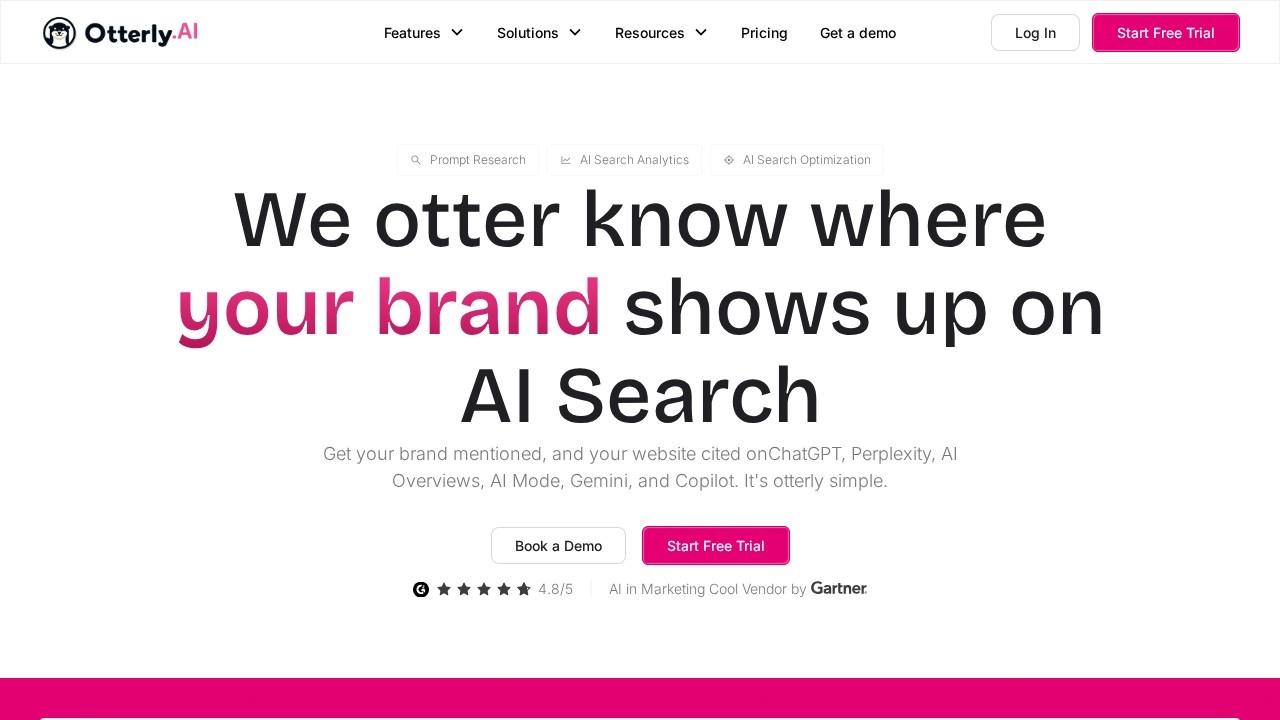
OtterlyAI tracks how your brand appears in AI‑generated search results, covering major engines like ChatGPT, Google AI Overviews, Claude, Perplexity, Gemini, and Copilot. It shows whether your website is cited and where it ranks in the answer list, allowing you to monitor and improve AI content visibility. New users can start a free trial or request a demo to see the dashboard in action.
If you run marketing, PR, or content teams, the tool first crawls every page on your site to check crawlability, AI‑readiness, and citation potential. The audit produces a report with a predictive score and a brief that explains what needs fixing to raise citation likelihood. Input for these audits is simply your website URL; output is a visual breakdown of pages, scored metrics, and suggested changes. The same process applies when you add new content, allowing you to validate pages before publishing.
Once pages are verified, OtterlyAI's GEO (Geographic Optimization) feature offers on‑page recommendations. The platform analyzes the language, structure, and schema of your content and produces a list of optimizations that should make AI engines cite the page more often. You input the page URL and receive a set of actionable items: tag adjustments, content clarifications, or formatting changes. These suggestions are derived from experiments like “Markdown vs. HTML” and “Does Schema Markup Really Impact AI Search?” which the company publishes on its blog.
The analytics module lets you view brand coverage over time, including the number of mentions versus citations and the average brand position on each engine. It also supports competitor comparison by letting you pull data for up to five top competitors, showing their mentions and positions side by side. The interface presents this data in a report that can be filtered by date, engine, or tag. The output is a clean visual summary, often displayed with line graphs showing trends, and tables listing mention counts.
The intent‑mapping feature works by collecting the most common questions people ask AI about your industry. The tool pulls prompts from real searches, clusters them by intent, and displays them as a list. No coding is required; you just view the list and use it to plan content that answers those queries.
Details
- Pricing
- Free
- Release date
- 2026-07-23
- Last checked
- 8h ago
- Indexing
- noindex, follow
- Category
- Search
Suggest an edit
Sign in to suggest an edit.
Pros and cons
Pros
- Real‑time monitoring of brand mentions across all major AI search engines
- Predictive audit reports help fix issues before publishing
- GEO optimization reduces the need for repeated optimization efforts
- Supports a range of content sources from PR to social media
Cons
- No published pricing details on the website
- Limited information on integration options with other marketing tools
- The platform focuses solely on AI search visibility, not broader SEO metrics
Alternatives
 LlmrefsSEO platform for tracking and optimizing AI search engine performance.
 Perplexity AIPerplexity review (October 2026): the AI answer engine's features, verified Pro, Max and Enterprise pricing, pros, cons and alternatives on AIMAPER.
 FeloFelo is a multilingual AI search engine that turns results into slides, documents and pages, with a free tier and a Pro plan.
 Empathy CoEnterprise AI Search for Commerce with privacy and ethical values.
 Golinks Search Powered By ChatgptIf ai recruiting tasks are part of your routine, Golinks Search Powered By Chatgpt is worth testing against your own use cases. Their website, golinks.io, has the full details. The...
 Vengo AIThe tool is free, which keeps the barrier to entry low. You can try it before deciding whether it earns a permanent place in your workflow. It works well as...
 123rf AI Search EngineThe tool may appeal to individuals and teams looking for help with ai...
 Creaitor AIIt fits naturally into daily work. Whether you are handling a single quick task or a batch that would eat an afternoon, the tool keeps the pace steady. The feature...
 MachinetranslationIt is a practical choice for ai seo work, and the honest way to evaluate it is to give it a spin. Start at machinetranslation.com for the latest information. Teams...
 CopilotlyThe whole experience is built around finishing things. From the first run onward, you are guided toward complete, usable results rather than half-finished experiments. You will find a free plan,...
 ObenanIf ai marketing tasks are part of your routine, Obenan is worth testing against your own use cases. Their website, obenan.com, has the full details. You will find a free...
 Jasper AIJasper review (October 2026): AI marketing content platform with Brand Voice, agents and Canvas, verified Pro pricing, Business plan and trial details.