


Sign in to rate this tool.
Overview
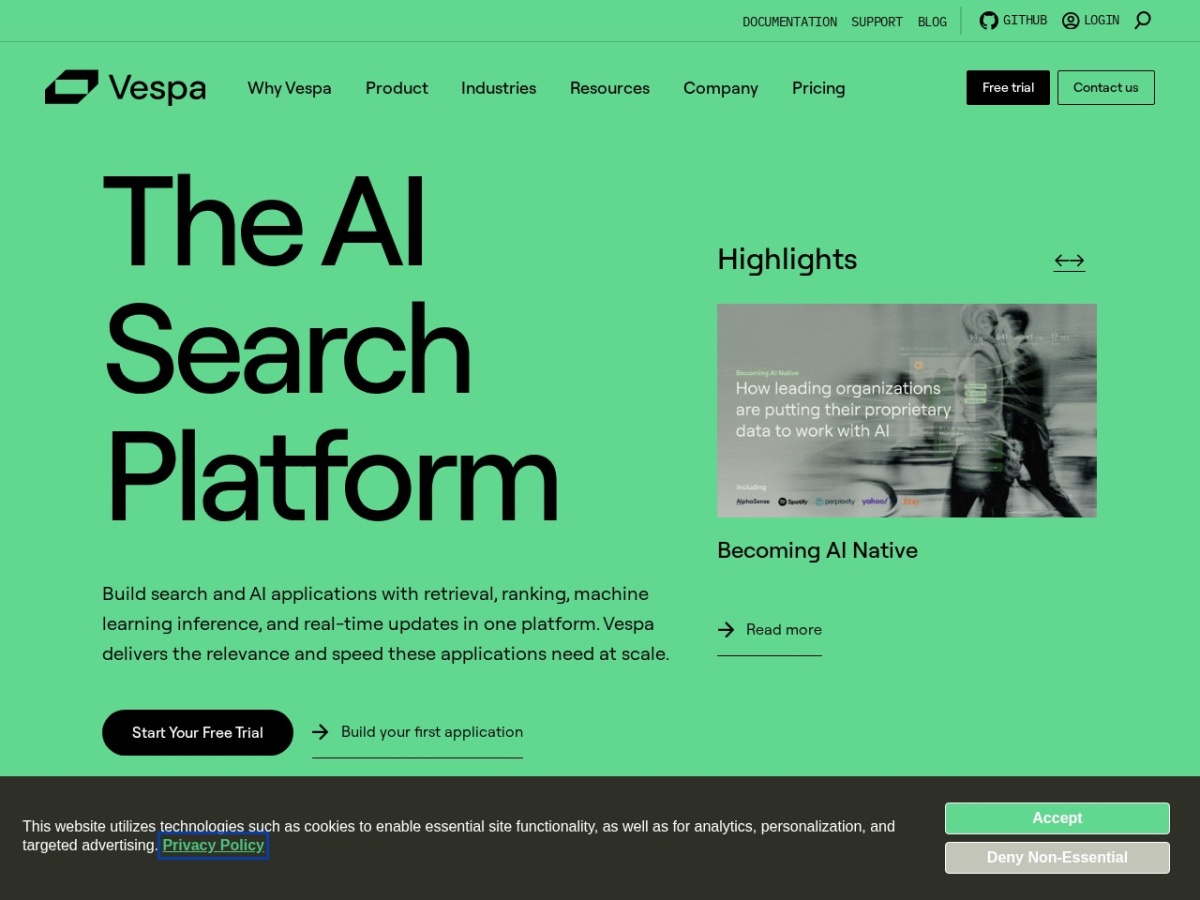
Vespa is an AI‑search platform that combines text, vector, tensor, and structured data search in a single system. It offers real‑time updates, distributed inference for ranking, and support for generative AI and recommendation use cases.
If you need to build a search or AI application that must handle billions of items and deliver results in under 100 ms, Vespa is designed for that scale. The platform lets you query over vectors, tensors, text, or structured fields and then apply a trained relevance model to rank the results. You can also retrieve documents, call machine‑learned models for additional inference, and stream the answers to your application in one request. The same engine is used for hybrid search, where vector similarity and keyword relevance are combined, and for recommendation systems that mix content retrieval with model scoring.
For developers working on recommendation, personalization or navigation in e‑commerce, Vespa provides a single source for product data, a search API, and a ranking API that takes structured and unstructured attributes. The platform also supplies a “streaming search” mode that reduces indexing costs for personal or private search scenarios, saving up to 20 × compared with full indexing. The documentation lists case studies from Spotify, Yahoo, and Farfetch, showing deployments that meet sub‑100 ms latency and need to scale to thousands of queries per second. Each of these customers integrates keyword analysis, vector search, and ranking models inside Vespa to serve highly relevant content to users.
The platform is available as a fully managed cloud offering on AWS, or can be self‑hosted. Vespa Cloud includes continuous deployment, upgrades, and strong security controls. It also ships a GitHub repository with samples and a blog that covers new features such as the fast‑search map fields. The pricing page states that a free trial is available, but no specific pricing tiers are published on the site.
Key features
- Distributed search engine for text, vectors, tensors, and structured data
- Integrated machine‑learned ranking inference for relevance
- Sub‑100 ms latency at scale of billions of items
- Hybrid search combining vector similarity and keyword matching
- Streaming search mode for personal/private queries, 20× cheaper than indexing
- Fully managed deployment on AWS with continuous upgrades
Details
- Pricing
- Free
- Category
- Search
Suggest an edit
Sign in to suggest an edit.
Pros and cons
Pros
- Handles billions of items with low latency
- Supports hybrid search and machine‑learned ranking in one API
- Provides streaming search for cost‑effective personal queries
- Strong community support via GitHub and documentation
- Case studies from major enterprises show real‑world deployment success
Cons
- No published pricing details beyond free trial offer
- Limited explicit information on pre‑built integrations
- Documentation focuses on architecture; deployment troubleshooting guidance less detailed
- No mention of specific SDKs for popular programming languages beyond API examples
Alternatives
 123rf AI Search Engine123RF is a long-running stock content marketplace that combines a large library of licensed media with a suite of AI creative tools.
 FeloFelo is a multilingual AI search engine that turns results into slides, documents and pages, with a free tier and a Pro plan.
 Empathy CoEnterprise AI Search for Commerce with privacy and ethical values.
 LlmrefsSEO platform for tracking and optimizing AI search engine performance.
 Qdrant IoQdrant is a high-performance vector search engine and database.
 Mple AImple AI is an enterprise platform that aims to guide sales teams in what to do, what to say and how to win each day.
 ImaggaImagga offers image and video recognition APIs that help businesses analyse, discover and moderate visual content.
 Kula AIKula is an applicant tracking system, or ATS, that describes itself as AI-native and built by recruiters.
 Copyowl AICopyOwl is an AI agent for deep research and writing.
 SloneekSloneek is an all-in-one HR system for managing employees and HR data.
 Hume AIEmpathic AI for voice and expression with emotional intelligence.
 Coefont CloudAI Voice Hub offering text-to-speech, voice changing, and AI voice creation.