


memgraph
High-performance open-source in-memory graph database for GraphRAG, AI memory, agentic AI, and real-time graph analytics. Cypher-compatible, built in C++.
Sign in to rate this tool.
Overview
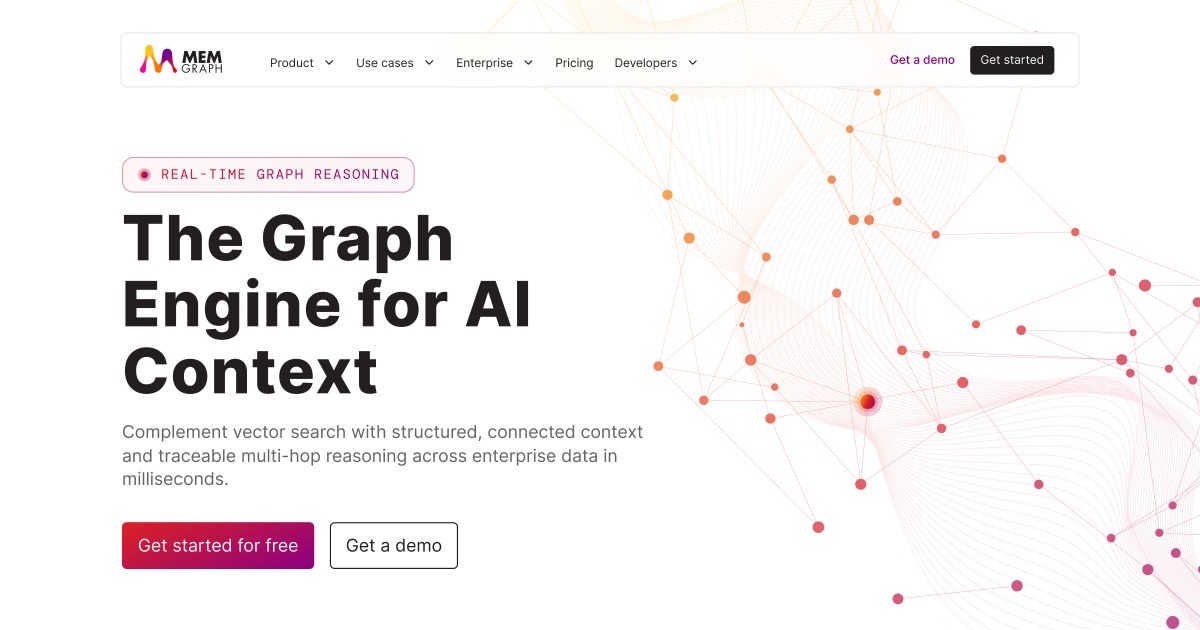
Memgraph is an in‑memory graph database written in C++ and Cypher‑compatible. The platform is aimed at AI and real‑time analytics workloads, GraphRAG, AI memory, agentic AI, fraud detection, and network analysis, by delivering sub‑millisecond traversals and supporting graph sizes from 100 GB to 4 TB. The Community Edition is free forever and includes a Python client, LangChain and LlamaIndex integrations, and an installation script that works on Linux, macOS, and Windows.
The engine stores data as a fully connected graph. You can import documents in PDF, XLSX, CSV, and SQL formats; the database builds nodes and relationships automatically, creating a knowledge graph that you can query in real time. Real‑time graph reasoning is enabled by combining vector search with multi‑hop traversal. For example, a GraphRAG workflow first retrieves a text chunk by similarity, then traverses the graph to follow relationships between entities, providing context that purely text‑based retrieval cannot reach. The same mechanism works for AI memory: long‑term memory is organized into semantic, episodic, and procedural nodes, and an LLM can request any of these types via a Cypher query and receive a structured result in milliseconds.
Agentic AI use cases rely on the graph as a path‑finding engine. A user query triggers a traversal that explores possible action sequences; edge scores represent the likelihood of each step, and the graph itself traces the decision path. The auditability of the path is exposed through the graph's structure, so the reasoning can be inspected or compared with alternative paths. These features make Memgraph suitable for teams that need transparent, auditable decision logic, such as security operations or compliance departments. It is not designed for simple flat‑table lookups or for scenarios that do not involve relationships between entities.
Performance figures are provided in the documentation: sub‑millisecond traversals, 1,000+ transactions per second for reads and writes, and ACID compliance when persistence is enabled. The system can be started with a single command and is compatible with Neo4j's Cypher syntax, making migration easier. However, the site does not publish pricing for enterprise editions, nor does it provide explicit benchmarks for specific workloads beyond the stated numbers. The documentation also lacks detailed code examples for complex multi‑step queries, so developers may need to refer to the official docs for deeper guidance.
Key features
Details
- Pricing
- Free
- Last checked
- 19h ago
- Indexing
- noindex, follow
Suggest an edit
Sign in to suggest an edit.
Pros and cons
Pros
- High‑performance in‑memory operations with low latency
- Supports multi‑hop reasoning across semantic, episodic, and procedural memory
- Compatible with popular AI frameworks through LangChain and LlamaIndex
- Migration path available for Neo4j users
- Open‑source Community Edition available at no cost
Cons
- Limited documentation examples for complex use cases
- No published pricing for enterprise editions in the public site
- Requires a Linux or Windows host for installation; no managed cloud offering listed
- Advanced features such as real‑time analytics are documented but not demonstrated with code snippets in the preview text
Alternatives
 LakesailThe tool is free, which keeps the barrier to entry low. You can try it before deciding whether it earns a permanent place in your workflow. Built for ai marketing...
 Qdrant IoThere is a deliberate calm to how Qdrant Io works. Loading screens are short, buttons do what they say, and your work is saved where you expect it to be....
 RaindropIt runs on a free model, so getting started is a low-risk decision. After a few sessions you will know quickly whether it fits. The flexibility shows when the same...
 Quills AIFor a straightforward look at an option like this, Quills AI is a sensible place to start. Visit quills.ai to see live examples and up-to-date details. The tool is free,...
 CerebriumIt is a practical choice for ai coding work, and the honest way to evaluate it is to give it a spin. Start at cerebrium.ai for the latest information. The...
 Iprep AIPricing is free, and there is no pressure to commit before you have seen results in your own context. Freelancers use it to keep client work moving, while in-house teams...
 DynamiqYou are not locked into a single way of doing things. Dynamiq supports your existing habits instead of forcing a new one, which makes adoption within a team much smoother....
 Granter AIWhat stands out most is predictability. The same input produces dependable output, which matters when you are producing work for clients or publishing on a schedule. Pricing is free, and...
 NovastartNovastart is an infinite canvas whiteboard OS. Open Chrome, ChatGPT, Claude, Word, Excel and your files side by side on one boundless, shareable whiteboard, invite teammates to shared canvases, and…
 Alian Hub Project Management SystemStudents and researchers find it handy for organizing notes and drafts, while agencies use it to keep deliverables consistent across multiple clients. Alian Hub Project Management System is a focused...
 Credo AIThere is a deliberate calm to how Credo AI works. Loading screens are short, buttons do what they say, and your work is saved where you expect it to be....
 Lakera GuardFor a straightforward look at an option like this, Lakera Guard is a sensible place to start. Visit lakera.ai to see live examples and up-to-date details. Lakera Guard brings a...