


VelesDB
The explainable, local-first memory engine for AI agents. One ~9 MB binary fuses vector + graph + columnar under VelesQL; why() returns the evidence path behind
Sign in to rate this tool.
Overview
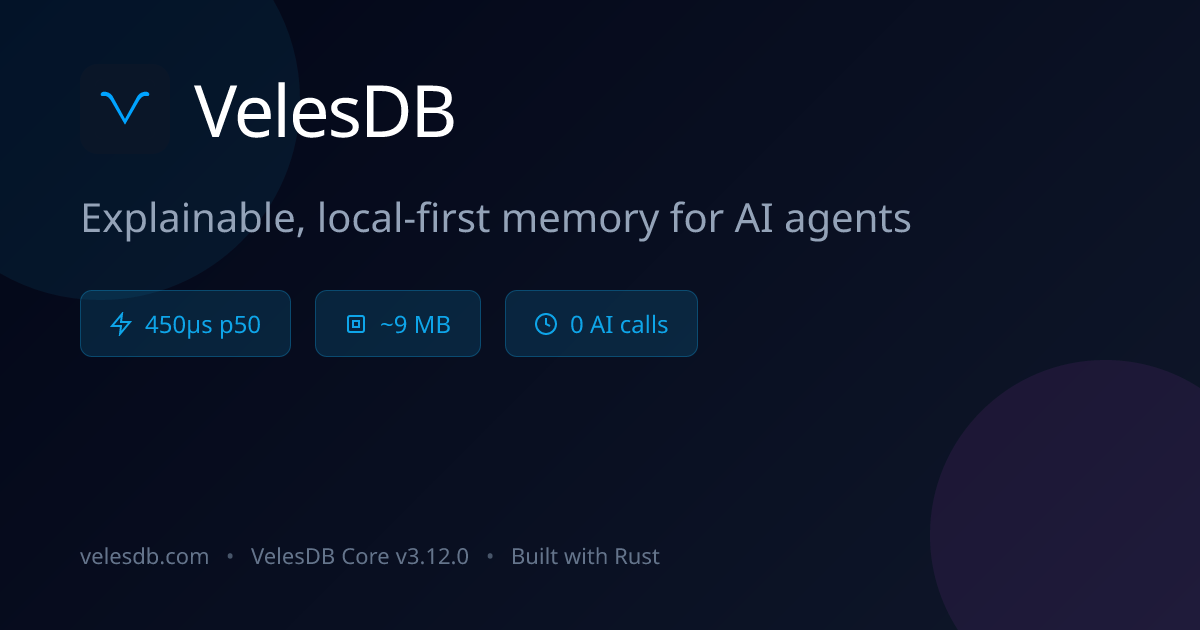
VelesDB is a local‑first memory engine for AI agents that combines vector, graph, and columnar storage into a single binary. The core rule is that everything runs offline; no external cloud service, no LLM calls, and no API keys are required. The bundle is around 9 MB, so it is lightweight enough for desktop, mobile, or browser deployments.
The system is built around three interrelated data types. Semantic memory lives in a native vector store, episodic memory is managed as a knowledge graph, and factual data is kept in a columnar store that also holds metadata. A single query surface, VelesQL, lets you filter structured data, search embeddings, and traverse relationships in a readable, SQL‑like syntax. Agents use an SDK that exposes store, recall, and why() functions. When you recall a fact, the engine returns the matched node and any typed links that reach it, together with a hop depth that shows how many relationships separate the evidence from the query.
Install VelesDB from pip, or clone the Rust repository. The API can be called from Rust, Python, Node.js, or WebAssembly, and you provide a path to a local database file. In your code you remember a string, optionally linking it to another stored node, and later you can ask why() to see the evidence trail. The engine writes to a write‑ahead log and can be run with WAL enabled, giving proven consistency. End‑to‑end search latency at the 50th percentile is about 10 µs for 10 k–384D vectors, and recall accuracy is reported at around 96 %.
Because the engine runs close to data, it can compile context into a deterministic token budget without involving a language model. A bundled context‑optimizer skill prefers to preserve or externalise fragments that are legal or exact, using recoverable ctx://source handles for overflow. The whole package can be deployed as an air‑gapped instance, supporting tenant isolation and forensic replay.
Key features
- Embedded binary (~9 MB) that holds vector, graph, and columnar memory
- Local vector search, graph traversal, and structured querying through one SQL‑like language
- Explanation of recall via why() that returns nodes, edges, and hop depth
- No external cloud, LLM calls, or API keys required
- Supports Rust, Python, Node.js, and WebAssembly deployments
- Write‑ahead log and deterministic context compilation for auditability
Details
- Pricing
- Free
Suggest an edit
Sign in to suggest an edit.
Pros and cons
Pros
- Whole system runs locally, eliminating cloud dependencies
- Unified engine eliminates need for separate databases for semantic, relational, and structured memory
- Positioned API enables memory operations directly in the agent runtime
- Evidence trail visibility supports debugging and compliance
Cons
- No published pricing or subscription information
- Limited to local deployment; no built‑in multi‑tenant scaling features
- Integration with external services requires additional tooling
- Documentation is minimal beyond basic installation and API snippets
Alternatives
 RaindropRaindrop is a monitoring and debugging platform for teams that ship AI agents.
 DynamiqDynamiq is an agentic AI platform for building and running AI agents for back-office automation and customer support, by voice and by chat.
 Empathy CoEnterprise AI Search for Commerce with privacy and ethical values.
 ConsensusConsensus searches peer-reviewed papers and writes cited answers, with a Consensus Meter that shows how the evidence splits on yes/no questions.
 ChatGPTChatGPT review (October 2026): features, verified Free, Go, Plus and Pro pricing, who it suits, pros, cons and alternatives on AIMAPER.
 Cover Letter CopilotCover Letter Copilot is an AI tool that writes cover letters for job applications.
 Qdrant IoQdrant is a high-performance vector search engine and database.
 Quills AIQuills AI is a generative business intelligence assistant.
 CopilotlyCopilotly is an AI assistant built around specialists rather than a single general chatbot.
 Cheers Yc S24Cheers: NFC-enabled badges for in-person business, streamlining reviews, feedback, and employee management.
 Credo AICredo AI is an AI governance platform for enterprises.
 BeamBeam is a native macOS app that puts ChatGPT one hotkey away.